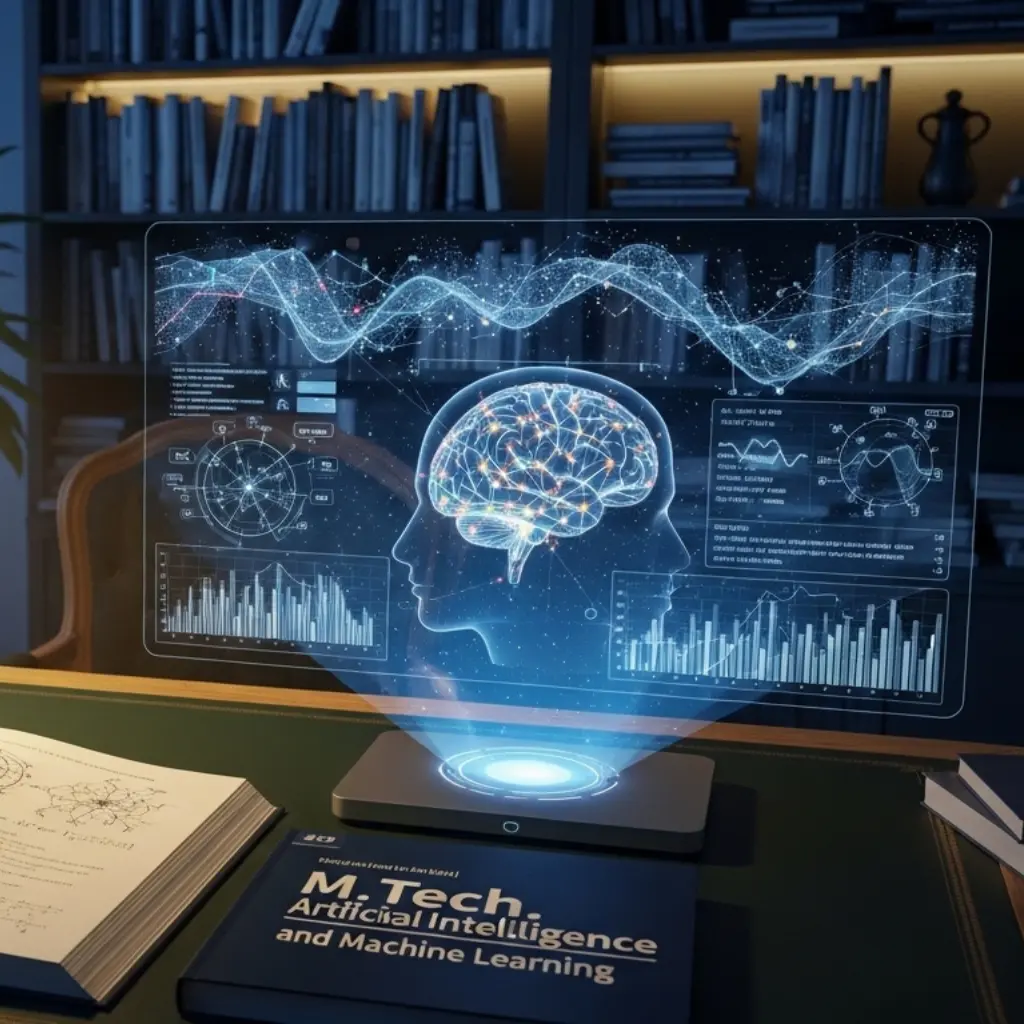
M.Tech. Artificial Intelligence and Machine Learning

B.Tech AI & ML Program

Programme Overview

The M.Tech. Artificial Intelligence and Machine Learning programme is a 2-year postgraduate course designed to develop advanced expertise in intelligent systems and data-driven technologies. The programme focuses on core areas such as artificial intelligence, machine learning, deep learning, natural language processing, and computer vision.

The curriculum blends strong theoretical foundations with practical applications, enabling students to design, develop, and deploy intelligent solutions for complex real-world problems. With a strong emphasis on research, innovation, and interdisciplinary learning, students gain hands-on experience through advanced labs, projects, internships, and dissertation work.

Overview background

Programme Highlights

Interdisciplinary icon

Advanced curriculum focused on AI and machine learning technologies

Industry aligned icon

Specialization in deep learning, NLP, computer vision, and intelligent systems

Hands-on learning icon

Strong emphasis on research, innovation, and real-world applications

Capstone projects icon

Hands-on learning through projects, labs, and industry collaborations

AI AgriTech icon

Access to modern AI tools, platforms, and computing infrastructure

Global readiness icon

Opportunities for internships, publications, and research projectsp>

Entrepreneurship icon

Industry-aligned electives in emerging AI domains

Entrepreneurship icon

Preparation for both industry and research/academic careers

Career Pathways

Graduates of the programme can pursue advanced roles across industries such as IT, healthcare, finance, robotics, and research organizations..

Career Roles Include:

AI Engineer

Machine Learning Engineer

Data Scientist

AI Research Scientist /p>

Computer Vision Engineer

NLP Engineer

The programme also provides a strong foundation for pursuing Ph.D. and advanced research in artificial intelligence and machine learning.

Programme Structure

The M.Tech. Artificial Intelligence and Machine Learning programme is a 2-year postgraduate program divided into 4 semesters, comprising a total of 68 credits. The curriculum combines strong theoretical foundations with practical exposure through advanced laboratories, projects, internships, seminars, and a research-driven dissertation. Emphasis is placed on innovation, critical thinking, and industry relevance, preparing graduates for both professional careers and higher research pursuits.

Semester-wise Curriculum Overview

Semester 1 – Advanced Foundations: Establishes advanced foundations in computing and artificial intelligence through in-depth study of data structures, algorithms, and computing systems for efficient and scalable solution design. Strengthens mathematical concepts essential for AI, including linear algebra, probability, and optimization. Research methodology equips students with skills for scientific investigation and innovation, while elective courses offer flexibility to specialize in emerging AI and machine learning domains.

Semester 2 – AI & ML Core: Focuses on core and advanced AI technologies, including artificial intelligence, machine learning, deep learning, and specialized areas such as natural language processing and computer vision. Enables students to develop intelligent, data-driven systems for complex real-world applications. Elective courses provide opportunities for specialization in emerging domains, while mini projects and seminars enhance practical skills, research aptitude, and technical communication.

Semester 3 – Advanced Learning & Research: Emphasizes advanced learning and research through specialized electives in AI and machine learning, such as reinforcement learning, AI ethics, and advanced analytics. Provides practical exposure through industry internships or research work, enabling students to apply their knowledge to real-world challenges. Dissertation – Phase I initiates independent research, focusing on problem identification, literature review, and the development of innovative AI-driven solutions.

Semester 4 – Dissertation & Specialization: Focuses on the completion of the dissertation (Phase II), where students implement, validate, and refine their AI/ML models and research outcomes. It culminates in project completion and encourages research publication, enabling students to contribute to scholarly work and demonstrate advanced expertise in artificial intelligence and machine learning.

Semester-wise curriculum graph
Footer banner

Eligibility Criteria

Education qualification icon

Candidates must have a Bachelor’s degree (B.E./ B.Tech.) in Computer Science and Engineering or in Computer Science and Engineering allied discipline from a recognized university.

Entrance examination icon

A minimum of 60% aggregate marks (or equivalent CGPA) as per university/AICTE norms.

Entrance examination icon

A valid score in GATE or any relevant national/state/university-level entrance examination.

Entrance examination icon

Candidates from allied branches such as IT, Electronics, or equivalent may also be considered as per university / AICTE norms.

Footer banner

Fee Structure

Students Under Indian Category ₹ Per Annum
Academic Fees ₹ 3,00,000
Hostel Fees
(2 Sharing Includes Room & Mess Charges)
₹ 1,50,000
Hostel Fees
(4 Sharing Includes Room & Mess Charges)
₹ 1,25,000
Caution Deposit
(Refundable at the End of the Course or After Graduation)
₹ 20,000
Students Under NRI/PIO/FO Category $ USD Per Annum
Academic Fees $5000
Hostel Fees
(Includes Room & Mess Charges)
$2500
Caution Deposit
(Refundable at the End of the Course or After Graduation)
$400

Refund Rules:
Fee refund & cancellation policy will be as per guidelines published by UGC/Statutory authorities.

Footer banner

Important Dates

Important dates icon

Admissions for the academic year 2026-27 are now open.

Note:
Dates and schedules are subject to change.

Footer banner

Kaveri University was established as per the Telangana Private Universities (Establishment & Regulation) Act, 2018 under section 3.

Admissions Open 2026-27