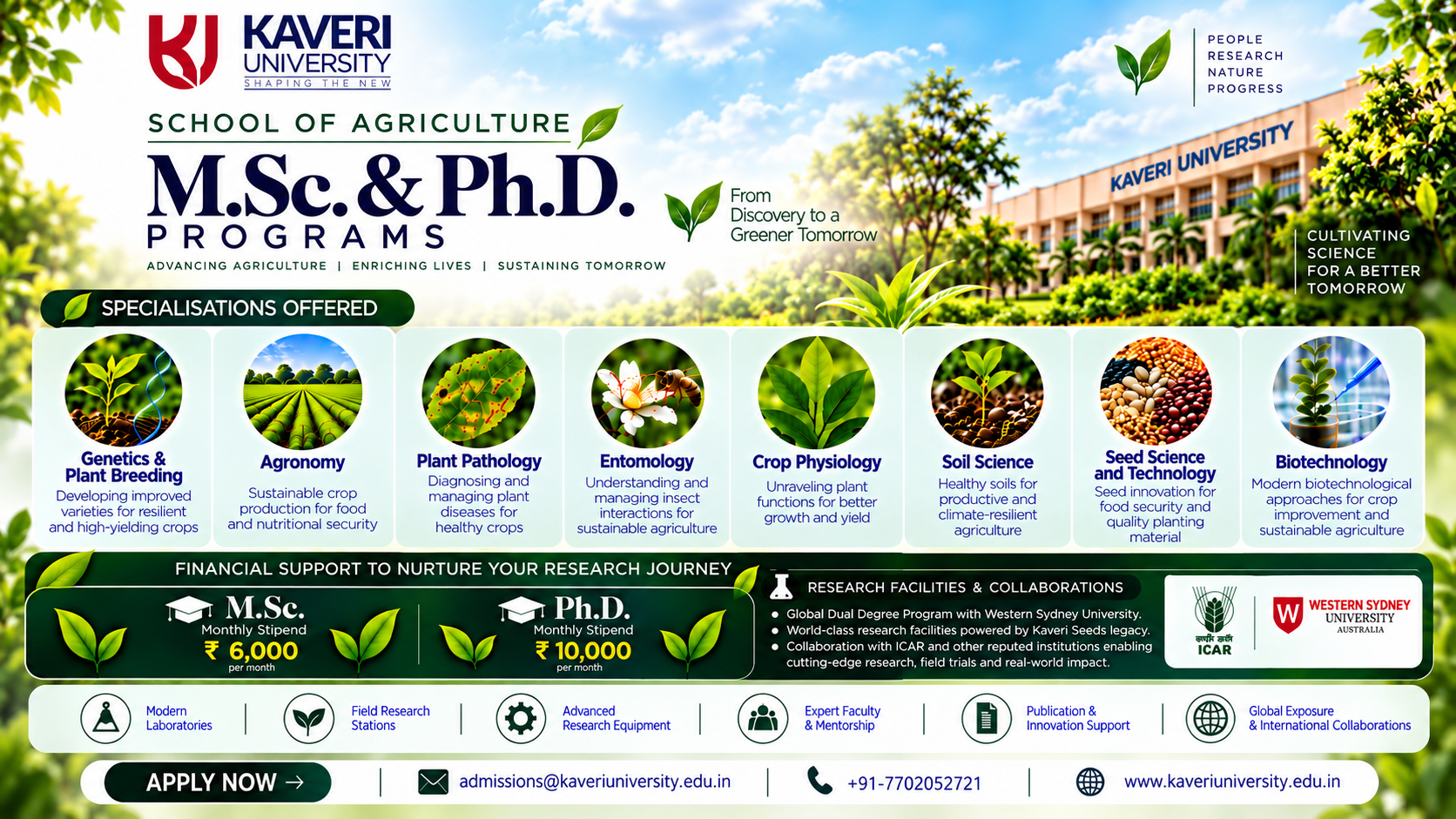
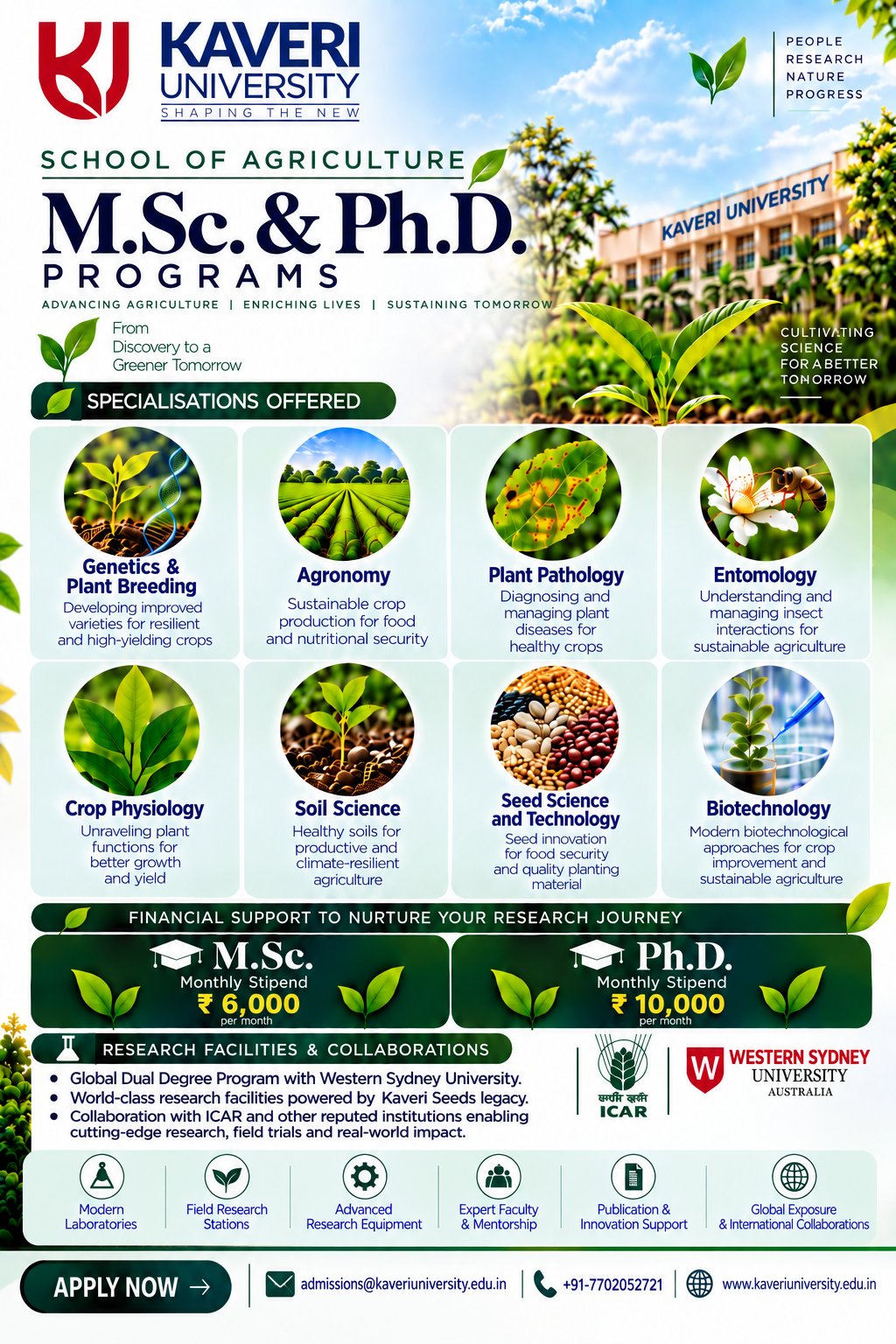
M.Sc. Entomology

Entomology Program

Programme Overview

The university offers a specialized post graduate programme (M.Sc. & Ph.D.) in Entomology aimed at developing skilled professionals in crop protection by diagnosing insect pests problems and their management and industrial entomological technologies. The program combines rigorous academic instruction with hands-on research and practical exposure, preparing students to address real-world challenges in agriculture.

A key strength of this program lies in its exceptional industry and field integration, made possible through collaboration with the Kaveri Seed Company—Kaveri University's sponsor and a prominent leader in Indian agriculture. Students receive hands-on exposure to state-of-the-art entomological research facilities, including insect-rearing units, bioassay laboratories, and integrated pest management (IPM) field stations. They also gain access to real-time pest surveillance programs, insecticide resistance monitoring, mass rearing units for biocontrol agents, and pest–crop interaction studies conducted in partnership with Kaveri Seed Company scientists. This direct engagement provides students with valuable industry-aligned experience and practical insight into contemporary pest management challenges.

The curriculum covers advanced themes such as insect taxonomy, molecular diagnostics, chemical ecology, host–pest interactions, insecticide toxicology, biological control, and climate-smart pest management. Students are supported by well-equipped labs featuring molecular tools for species identification, pheromone analysis facilities, bio-efficacy testing units, and controlled growth chambers for pest behavior studies.

Beyond the university's internal strengths, the program is enriched through collaborations with national research institutes such as ICAR institutes and regional agricultural research stations, along with international universities working on frontier areas of insect science. These partnerships broaden students' exposure to global entomological practices, collaborative research opportunities, and innovative pest management technologies.

With a strong emphasis on innovation, sustainability, and field applicability, the Postgraduate Programme in Entomology at Kaveri University prepares students to excel in agricultural research organizations, agrochemical industries, biocontrol companies, seed corporations and extension services focusing on IPM and pest risk management.

Our Vision

To develop globally competent entomology professionals capable of addressing emerging pest problems and contributing to sustainable agriculture through scientific innovation and technology-driven pest management.

To advance cutting-edge research in insect science by integrating molecular diagnostics, chemical ecology, biological control and precision pest management strategies for resilient crop production.

To strengthen national and international collaborations that offer students global exposure, interdisciplinary learning and industry-oriented training, ensuring academic depth and professional readiness.

Programme Highlights

Specialized curriculum focused on insect biology, pest management, insect taxonomy, toxicology, insect ecology and biological control.

Access to modern entomological research facilities, including insect-rearing labs, molecular diagnostic tools, pheromone units, and bioassay laboratories.

Training in advanced techniques such as DNA barcoding, insecticide resistance profiling, semiochemical-based pest management, and classical and augmentative biocontrol.

Strong industry linkage with the Kaveri Seed Company, providing real-world exposure to pest monitoring, resistance management, and IPM strategies in commercial crop production.

Prepares students for careers in research institutions, agrochemical and biocontrol industries, seed companies, quarantine services, and international research collaborations.

Program Overview Background

Curriculum Overview

The programme encompasses a wide range of advanced topics in Entomology, with core emphasis on insect taxonomy, morphology, physiology, toxicology, molecular entomology, insect ecology, IPM, biological control, chemical ecology, and pest surveillance. Students also gain exposure to emerging areas such as climate change impacts on pests, insect–plant interactions, molecular diagnostics, and resistance management.

Through both theoretical learning and rigorous practical training, the curriculum equips students with the scientific depth and applied skills necessary to tackle real-world pest management challenges and contribute meaningfully to sustainable agriculture and crop protection.

Duration:

M.Sc.: 2 years (4 semesters)

Ph.D.: 3 years (6 semesters)

Objectives:

To equip students with advanced knowledge and practical skills in insect biology, pest management, toxicology, and molecular entomology, enabling them to develop effective, sustainable, and scientifically sound strategies for managing key agricultural pests.

To prepare industry and research-ready professionals capable of addressing global challenges in crop protection, invasive pest management, biosecurity, and climate-driven pest outbreaks, through innovation, critical analysis, and multidisciplinary collaboration.

To foster expertise in Integrated Pest Management (IPM), biological control, insect diagnostics, and resistance management, ensuring graduates can contribute to environmentally responsible and economically viable pest management solutions.

Programme Structure

Kaveri University's School of Agriculture offers a comprehensive Postgraduate Programme in Entomology, emphasizing advanced research, practical skill development, and innovation in insect science and pest management. The programme integrates hands-on laboratory training, field-based pest surveillance, industry collaboration, and exposure to cutting-edge molecular and diagnostic tools.

With a curriculum structured around experiential learning, research-driven coursework, and strong industry linkages, students gain both academic depth and real-world competencies essential for careers in crop protection, agrochemical industries, biocontrol enterprises, and research organizations.

This programme is designed to cultivate future leaders in entomological research and pest management, equipping postgraduate scholars with the scientific foundation, technical proficiency, and industry exposure required to excel across academia, industry, extension services, and policy sectors.

Program Structure Graph

Key Areas of Study

Insect Morphology & Taxonomy: Study of insect structure, classification, and identification techniques to accurately diagnose pest species affecting various crops.

Insect Ecology & Population Dynamics: Understand insect behavior, life cycles, host–pest interactions, and population regulation to develop effective pest management strategies.

Integrated Pest Management (IPM): Learn ecologically sustainable pest control approaches integrating cultural, biological, mechanical, and chemical methods.

Insect Physiology & Biochemistry: Explore physiological processes such as digestion, respiration, reproduction, and insect biochemical pathways relevant to pest control.

Insecticide Toxicology & Resistance Management: Study the mode of action of insecticides, mechanisms of resistance, and strategies to mitigate resistance development in field populations.

Biological Control & Biopesticides: Gain expertise in using parasitoids, predators, entomopathogens, and microbial pesticides for environmentally friendly pest suppression.

Molecular Entomology & Diagnostics: Apply molecular tools such as DNA barcoding, PCR-based diagnostics, and genetic markers to identify pests, track invasions, and monitor insecticide resistance.

Chemical Ecology & Semiochemicals: Learn about pheromones, allelochemicals, and behavioral manipulation methods used for monitoring and controlling pest populations.

Pest Forecasting & Surveillance: Understand forecasting models, pest monitoring tools, GIS-based mapping, and climate-driven pest emergence predictive systems.

Career Opportunities

Entomologist / Pest Management Specialist – Work in agricultural research institutions, state agriculture departments, or private companies to design and implement pest management programs in rural and urban areas.

Research Scientist (ICAR/IARI/International Centres) – Conduct advanced research in insect biology, IPM, toxicology, biocontrol, or molecular entomology.

Agrochemical & Biocontrol Industry – Engage in product development, bioefficacy testing, toxicological evaluation, and field validation of pesticides and biopesticides.

IPM Consultant / Crop Protection Advisor – Provide expert guidance to farmers, seed companies, and agribusiness firms on sustainable pest management solutions.

Quarantine & Biosecurity Officer – Work in national and international plant quarantine services to detect, prevent, and manage invasive and exotic pest species at airport, seaport and land port.

Extension Specialist – Support pest surveillance programs, farmer training, and large-scale IPM demonstrations.

Academic Careers – Pursue teaching and research roles in universities and agricultural colleges.

Entrepreneurship Opportunities – Apiculture, sericulture, lac culture, urban pest management and BSF in urban waste management.

Footer Banner

Credit Load – M.Sc.

Summary of Credit Distribution Among Different Categories of the
Course (Credit Hours)

Semester Major Courses Minor Courses Supporting Courses Common Courses Seminar Research Total
I 14 3 3 3 -- -- 23
II 14 5 -- 2 -- -- 21
III -- -- 3 -- 1 15 19
IV -- -- -- -- -- 15 15
Total 28 8 6 5 1 30 78

Credit Load - Ph.D.

Summary of Credit Distribution Among Different Categories of the
Course (Credit Hours)

Semester Major Courses Minor Courses Supporting Courses Seminar Research Total
I 9 6 -- -- -- 15
II 6 -- 5 1 3 15
III -- -- -- 1 18 19
IV -- -- -- -- 18 18
V -- -- -- -- 18 18
VI -- -- -- -- 18 18
Total 15 6 5 2 75 100

Eligibility Criteria

M.Sc. Eligibility

M.Sc. The Program is open to candidates with Bachelor's degree in Agriculture or any equivalent degree from Institute/Colleges having ICAR accreditation and affiliated colleges with SAUs having ICAR accreditation or government-recognized private/autonomous university with a minimum CGPA of 6.00/10.00.

Ph.D. Eligibility

Ph.D. M.Sc. in Entomology with a minimum OGPA of 6.50/10.00 (or equivalent) from Institute/Colleges having ICAR accreditation and affiliated colleges with SAUs having ICAR accreditation or government-recognized private/autonomous university.

The basic degree of four (4) years duration from Institute/Colleges having ICAR accreditation and affiliated colleges with SAUs having ICAR accreditation or government-recognized private/autonomous university.

Footer Banner

Fee Structure

Students Under Indian Category ₹ Per Annum
Academic Fees
(All Inclusive Academic Fees)
₹ 3,00,000
Hostel Fees
(All Inclusive Hostel & Mess Charges)
₹ 1,65,000
Caution Deposit
(Refundable at the end of study and graduation)
₹ 20,000
Students Under NRI/PIO/FO Category $ USD Per Annum
Academic Fees $5,000
Hostel Fees
(Includes Room & Mess Charges)
$2,500
Caution Deposit
(Refundable at the End of the Course or After Graduation)
$400

Refund Rules:
Fee Refund & Cancelation Policy will be as per guidelines published by UGC / Statutory Authorities.

Footer Banner

Important Dates

Important Dates Icon

Important Dates to Remember (Subject to Revision)

Application Date Icon

Last Date to receive Application for Admissions – 5th August 2026

Merit List Icon

Merit List / Counselling 10th August 2026

Orientation Icon

Orientation and Classes Begin - 13th August 2026

Note:
Dates and schedules are subject to change.

Footer Banner

Kaveri University was established as per the Telangana Private Universities (Establishment & Regulation) Act, 2018 under section 3.

Admissions Open 2026-27