M.Sc. Agricultural Economics

...

Programme Overview

Kaveri University offers a comprehensive Post Graduate and Doctoral Programme (M.Sc. & Ph.D.) in Agricultural Economics, designed to develop professionals equipped with advanced analytical, research, and policy skills to address the evolving challenges of agriculture, rural development, food systems, and agrarian institutions. The programme blends strong theoretical foundations with quantitative analysis, field-based research, and policy-oriented learning to prepare students for leadership roles in research organisations, universities, development agencies, government institutions, and global organisations.

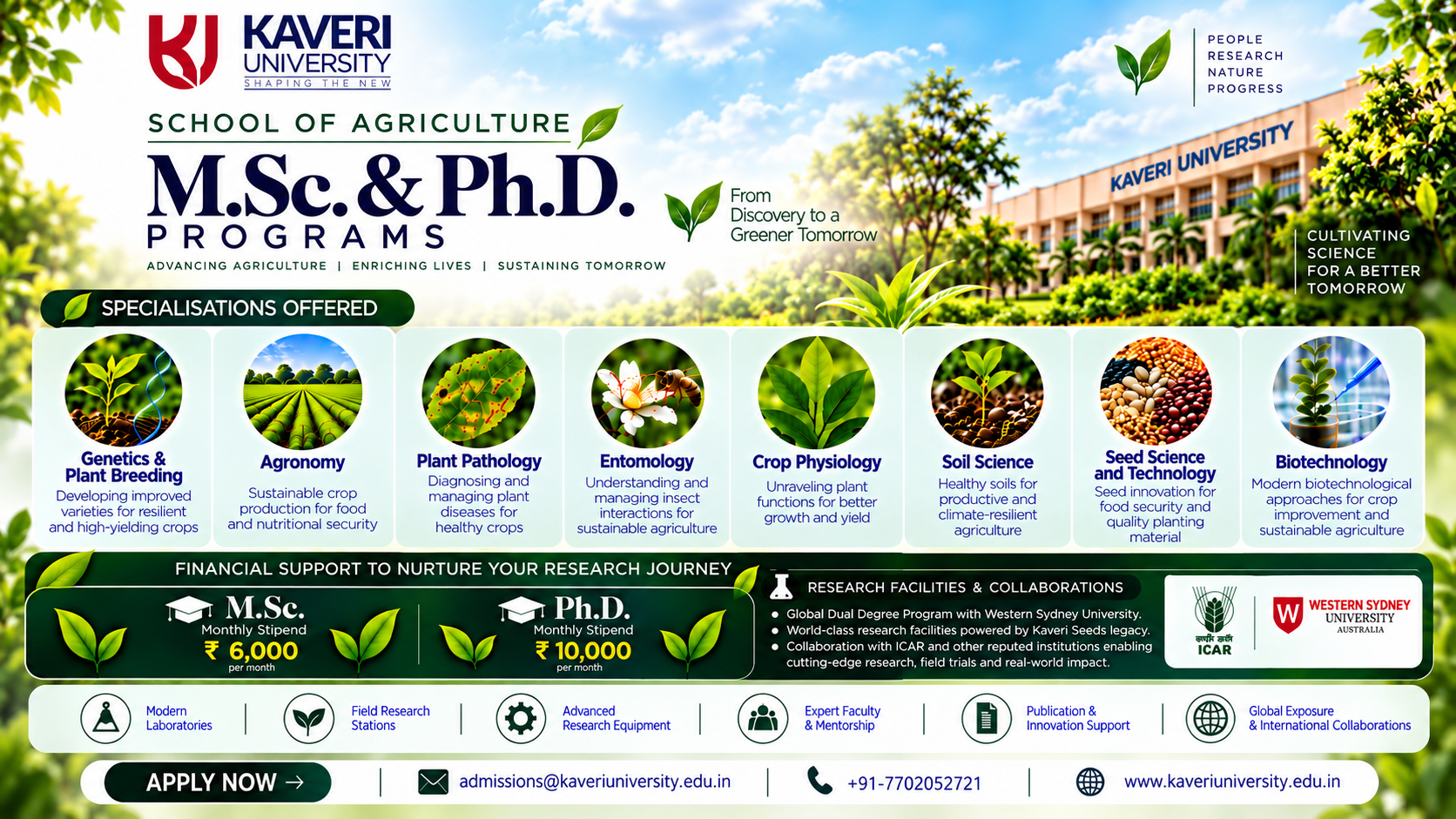
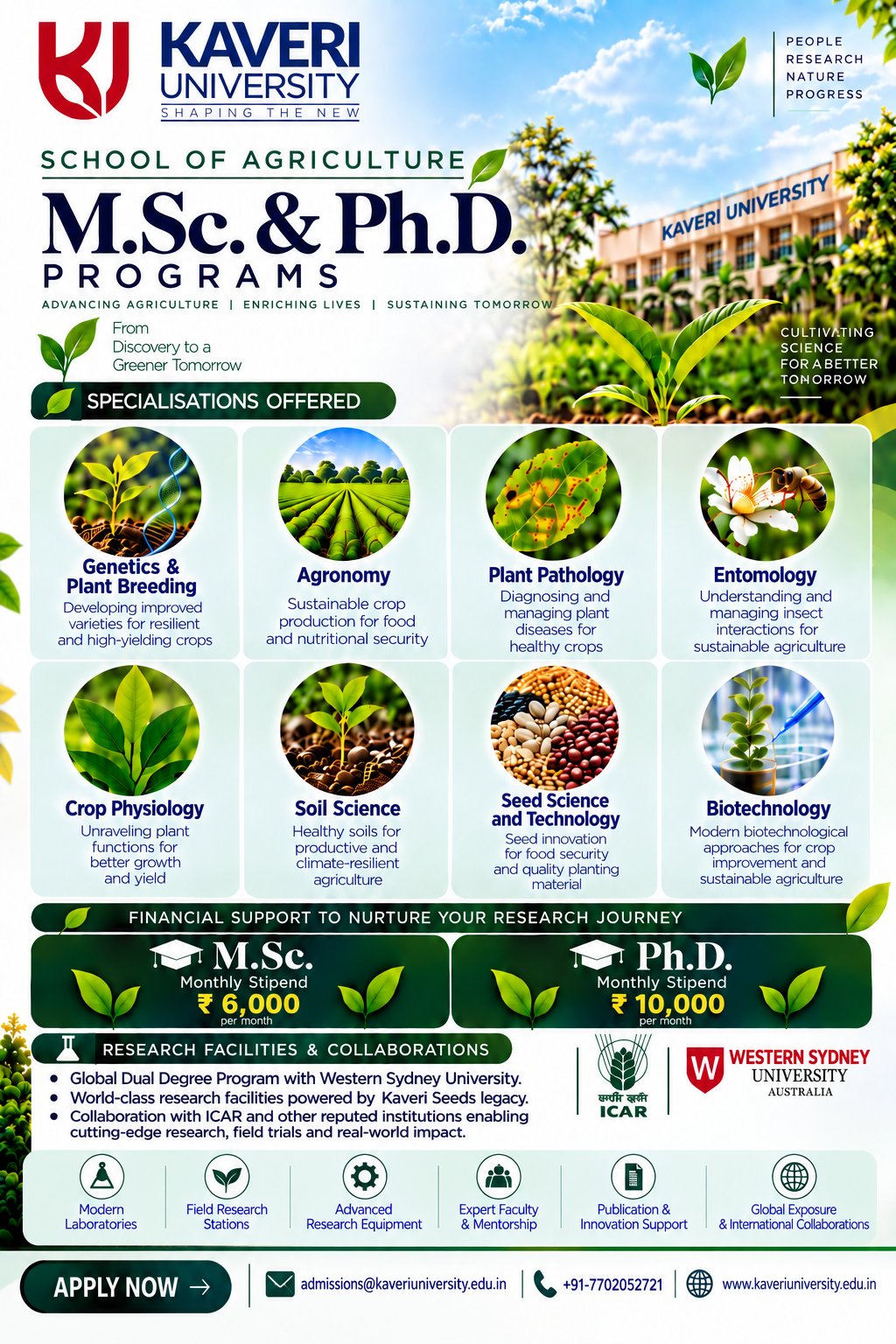
A major highlight of this programme is its academic integration with national and international agricultural research institutes, universities, development organisations, and policy think tanks. Students gain exposure to high-quality research environments and collaborate on field surveys, economic modelling, impact assessment studies, and policy-driven research through partnerships with institutions such as:

  • National and international agricultural research centres (e.g., ICAR institutions, SAUs, ICRISAT)
  • International organisations working on food systems and rural development
  • Global universities engaged in joint research and knowledge exchange
  • National planning and policy institutions, development agencies, and research foundations
  • The curriculum emphasizes advanced topics such as production economics, farm management, econometrics, resource economics, price policy, value chain analysis, climate change economics, technology impact assessment, and agricultural finance. Students also benefit from modern data analytics labs, statistical software, and access to global and national agricultural databases.

    With a strong commitment to sustainability, economic reasoning, and policy relevance, the Agricultural Economics programme at Kaveri University prepares graduates for impactful careers in research, policy, consultancy, international development, and academia.

    Our Vision

    To develop globally competent agricultural economists capable of advancing sustainable agriculture, food security, and rural development through innovative research and economic analysis.

    To promote high-quality research using advanced economic modelling, quantitative tools, and interdisciplinary approaches for addressing issues related to climate change, resource management, food systems, and agricultural markets.

    To strengthen collaborations with national and international research institutes and universities, ensuring students receive global exposure, research opportunities, and academic excellence.


    Programme Highlights

    Comprehensive curriculum covering production economics, farm management, resource economics, welfare economics, price policy, and agricultural development.

    Access to modern data analytics labs and statistical software (R, STATA, SPSS).

    Training in econometric modelling, impact assessment, value chain analysis, and climate change economics.

    Academic collaboration with national and international research institutes and universities.

    Field-based research through farm surveys, market studies, case analyses, and policy evaluation exercises.

    Opportunities for internships, joint research, and academic exchange through networking with global institutions.

    Prepares students for careers in research institutions, development organisations, government agencies, consultancy, agri-finance, and academia.

    Curriculum Overview

    The curriculum covers a comprehensive set of advanced topics, including micro and macro economics, production and cost functions, farm management and resource use efficiency, agricultural marketing and commodity price analysis, econometrics and advanced quantitative tools, climate change and resource use economics, agricultural finance and risk management, food security and development policy, and impact assessment with economic surplus methods. Students develop strong theoretical understanding, quantitative skills, and policy evaluation capabilities, supported by hands-on research exposure and field-based learning.

    Duration:

    M.Sc.: 2 years (4 semesters)

    Ph.D.: 3 years (6 semesters)

    Objectives:

    To provide advanced knowledge in agricultural economics, preparing students to contribute to sustainable agriculture and rural transformation.

    To build strong quantitative, analytical, and policy research skills necessary for economic modelling and programme evaluation.

    To prepare graduates for leadership roles in research, academia, planning bodies, development organisations, and global institutions.

    To promote research in physiological breeding, crop growth simulation, and resource-use efficiency.

    To prepare students for interdisciplinary roles in research, extension, and AgriTech-based crop advisory systems.

    To foster innovation in enhancing climate adaptability and improving the physiological efficiency of crops under diverse agro-ecological conditions.

    Programme Structure

    The programme is structured to offer rigorous academic training in economic theory and applied agricultural economics, complemented by extensive field-based exposure through surveys, market analysis, and real-world assessments. Students receive hands-on training in econometrics, data analysis, and modelling, supported by research mentorship aligned with national and international priorities. The programme also provides collaborative opportunities through linkages with global agricultural research networks. This holistic design ensures that graduates are thoroughly prepared for advanced research, development planning, policy formulation, and academic careers.

    ...

    Credit Load – M.Sc.

    Summary of Credit Distribution Among Different Categories of the
    Course (Credit Hours)

    Semester Major Courses Minor Courses Supporting Courses Common Courses Seminar Research Total
    I 9 3 3 3 -- -- 18
    II 11 5 -- 2 -- -- 18
    III -- -- 3 -- 1 15 19
    IV -- -- -- -- -- 15 15
    Total 20 8 6 5 1 30 70

    Credit Load - Ph.D.

    Summary of Credit Distribution Among Different Categories of the
    Course (Credit Hours)

    Semester Major Courses Minor Courses Supporting Courses Seminar Research Total
    I 7 6 -- -- -- 13
    II 5 -- 5 1 3 14
    III -- -- -- 1 18 18
    IV -- -- -- -- 18 18
    IV -- -- -- -- 18 18
    IV -- -- -- -- 18 18
    V -- -- -- -- 18 18
    IV -- -- -- -- 18 18
    Total 12 6 5 2 75 100

    Eligibility Criteria

    M.Sc. (Agricultural Economics)The Program is open to candidates with Bachelor's degree in Agriculture or any equivalent degree from Institute/Colleges having ICAR accreditation and affiliated colleges with SAUs having ICAR accreditation or government-recognized private/ autonomous university with a minimum CGPA of 6.0/10.00

    Ph.D. (Agricultural Economics) M.Sc. in Agricultural Economics with a minimum OGPA of 6.50/10.00 (or equivalent) from Institute/Colleges having ICAR accreditation and affiliated colleges with SAUs having ICAR accreditation or government-recognized private/ autonomous university. The basic degree of four (4) years duration from Institute/Colleges having ICAR accreditation and affiliated colleges with SAUs having ICAR accreditation or government-recognized private/ autonomous university.

    Note:
    (i) Students getting admitted through entrance test mode need to have 60% or equivalent grade in 10+2 from any Statutory Board.
    (ii) Exact cut-off rank would be announced upon declaration of results.

    Key Areas of Study

    Microeconomics & Macroeconomics Foundations of market behaviour, economic systems, and national economy.

    Production Economics & Farm Management – Resource optimisation, cost analysis, and farm-level decision-making.

    Agricultural Marketing & Price Analysis – Market structure, price forecasting, trade, and policy.

    Econometrics & Statistical Methods – Empirical analysis, modelling, and quantitative techniques.

    Natural Resource & Environmental Economics - Economic valuation, resource allocation, and climate change adaptation.

    Agri-Supply Chain & Value Chain Analysis – Understanding linkages across production, processing, and distribution.

    Agricultural Finance & Risk Management- Credit systems, insurance, and financial instruments in agriculture.

    Development Economics & Policy Analysis – Poverty, food security, rural development, and programme evaluation.

    Technology Adoption & Impact Assessment – Economic surplus, cost–benefit analysis, and evaluation of innovations.

    Career Opportunities

    Research Economist National and international agricultural research institutes, think tanks, and universities.

    Policy Analyst Government bodies, planning agencies, food security organisations, and policy think tanks.

    Development Economist International development organisations, NGOs, and rural development agencies.

    Economic Consultant Agribusiness, value chain advisory, sustainability consulting, and project analysis.

    Data Analyst / Economic ModellerStatistical modelling and forecasting across public and private sectors.

    Financial & Risk Management Specialist Banks, agricultural finance institutions, insurance companies, and rural credit systems.

    Academic & Teaching Careers Universities, research institutions, and higher education centres.

    Fee Structure

    Students Under Indian Category ₹ Per Annum
    Academic Fees<
    (All Inclusive Academic Fees)/td>
    ₹ 3,00,000
    Hostel Fees
    (All Inclusive Hostel & Mess Charges)
    ₹ 1,65,000
    Caution Deposit
    (Refundable at the end of study and graduation)
    ₹ 20,000
    Students Under NRI/PIO/FO Category $ USD Per Annum
    Academic Fees $5,000
    Hostel Fees
    (Includes Room & Mess Charges)
    $2,000
    Caution Deposit
    (Refundable at the End of the Course or After Graduation)
    $400

    Refund Rules:
    Fee Refund & Cancelation Policy will be as per guidelines published by UGC / Statutory Authorities.

    Important Dates

    Important Dates to Remember (Subject to Revision)

    Last Date to receive Application for Admissions–

    Merit List / Counselling

    Orientation and Classes Begin -

    Note:
    Dates and schedules are subject to change.

    Kaveri University was established as per the Telangana Private Universities (Establishment & Regulation) Act, 2018 under section 3.