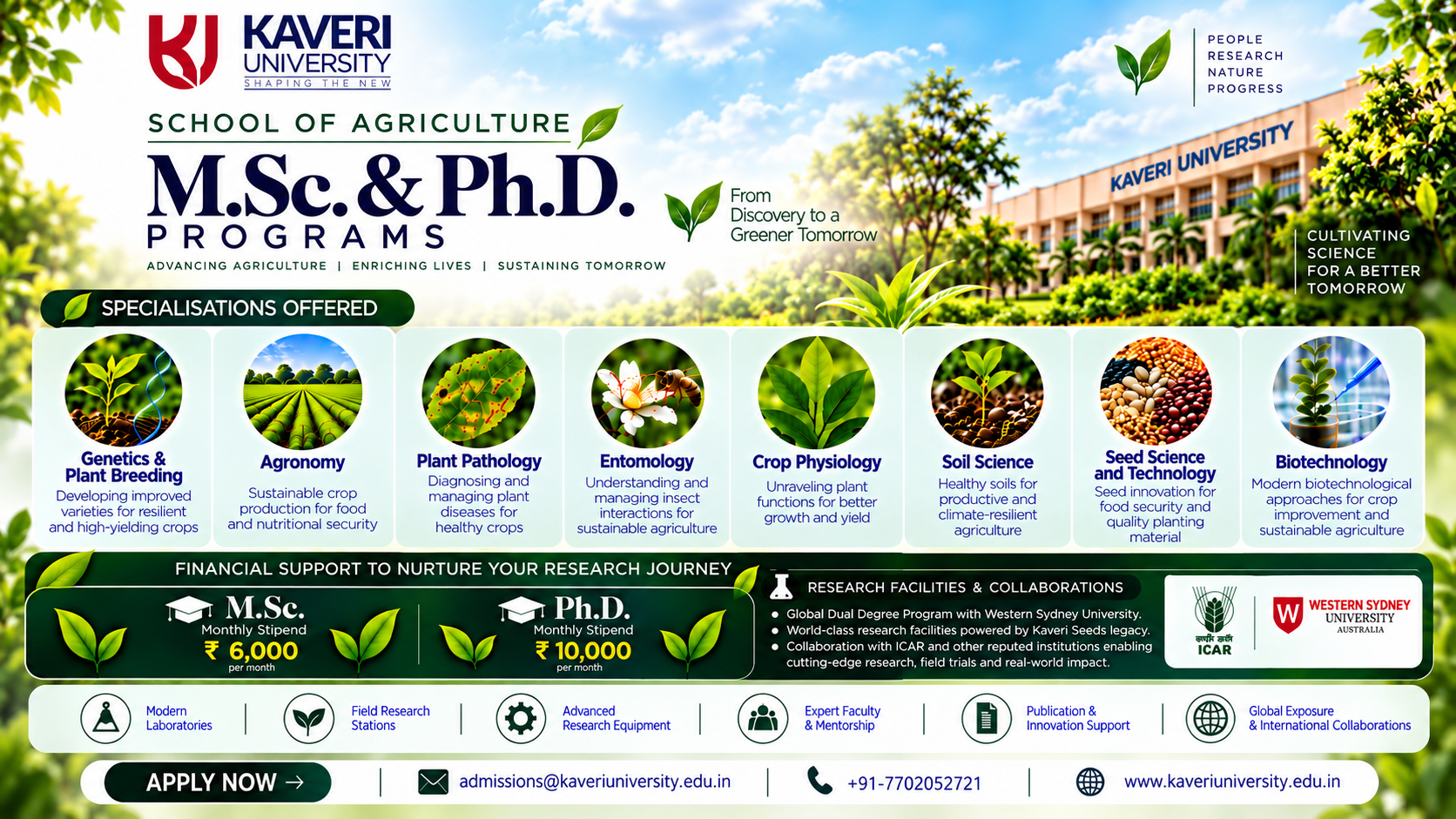
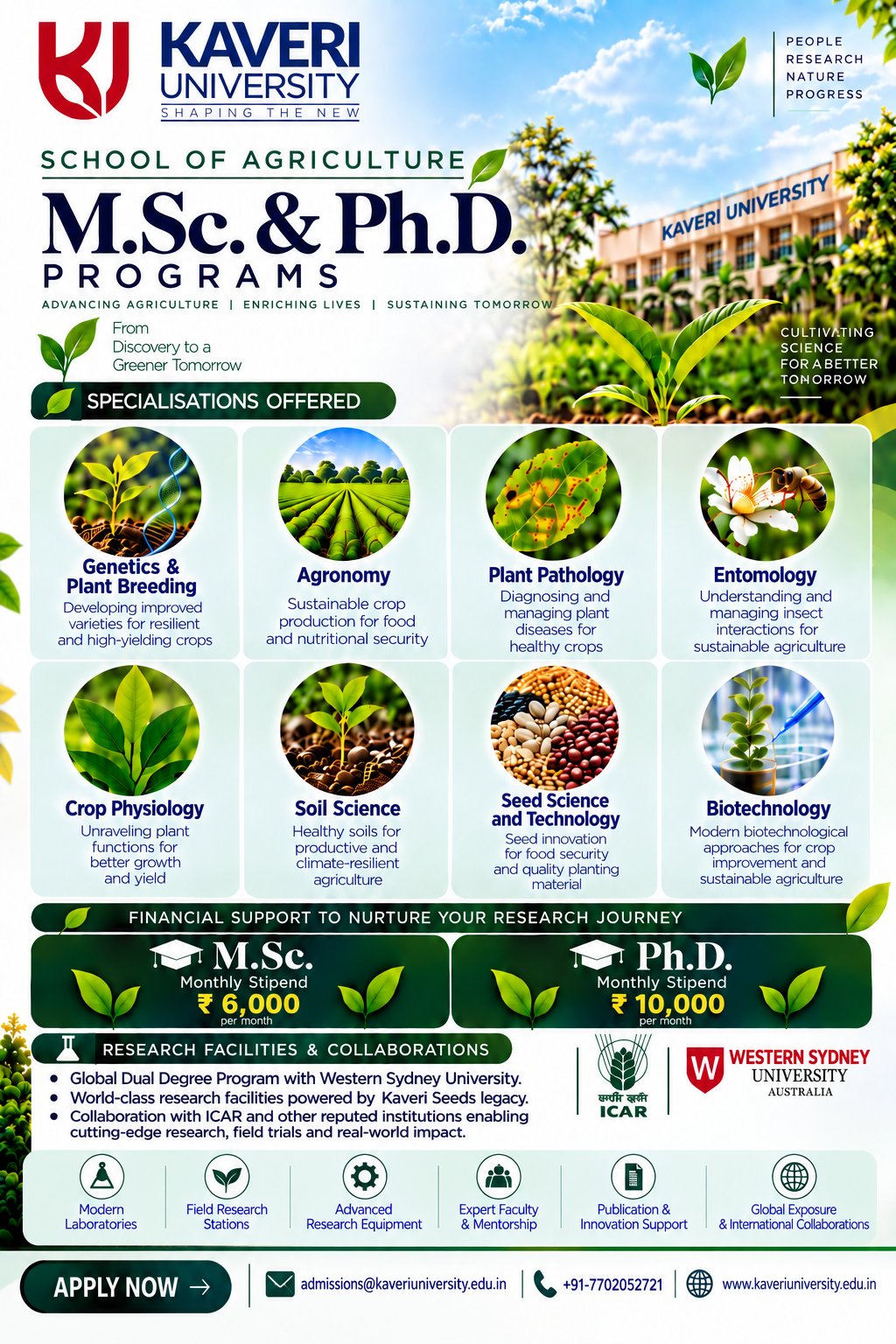
PG Programme (Agronomy)

...

Programme Overview

The evolving landscape of global agriculture demands innovative solutions to address food security, resource management, and climate resilience. A Postgraduate Programme in Agronomy with a specialization in Kaveri University in Precision Agriculture, Automation, and Water Management is both timely and essential. This programme aims to cultivate professionals equipped with advanced knowledge and practical skills to revolutionize modern agronomic practices through the integration of technology, data science and sustainable resource management.

The programme is designed to bridge the gap between traditional agronomic principles and next-generation agri-technologies, thereby supporting the agricultural sector's transition to smart, data-driven, and sustainable farming systems.

This postgraduate programme will position the new university as a leader in advanced agronomic education and innovation. By focusing on precision, sustainability, and technology, it will produce professionals and researchers capable of tackling the grand challenges of 21st-century agriculture in research, academia and industry.

Our Vision

To become a centre of excellence in agronomic education and research by producing globally competent professionals capable of leading the transformation of agriculture through precision technologies, intelligent automation, and sustainable water management practices.

Programme Highlights

To provide in-depth theoretical and practical knowledge in core and advanced areas of agronomy.

To enable students to integrate precision agriculture technologies such as remote sensing, GPS, GIS, and IoT in crop production systems.

To develop proficiency in automation tools including robotics, AI and machine learning for smart farming.

To promote the development and implementation of innovative water management strategies that enhance productivity and conserve resources.

To foster interdisciplinary research and collaboration with industry, government and international bodies

Entrepreneurship: Start-ups in sensor-based farming, hydroponics, data- driven advisory services, or smart irrigation systems.

Curriculum Overview

The curriculum will undergo regular reviews in consultation with:

Academic and industry experts

Alumni feedback

Technological advancements

National and international agricultural policy developments focusing important aspects related to Agriculture covered in SDG’s

Research and Innovation Focus

The programme emphasizes hands-on research through:

Precision field trials.

Use of drone and sensor technologies

Simulation modelling for crop-water-climate interactions

Industry collaborations for real-world automation projects

Students will have access to labs, smart farms, climate-controlled greenhouses, protected structures and digital simulation tools to support experiential learning and applied research.

Duration:

M.Sc.: 2 years (4 semesters)

Ph.D.: 3 years (6 semesters)

Objectives:

To provide in-depth theoretical and practical knowledge in core and advanced areas of agronomy.

To enable students to integrate precision agriculture technologies such as remote sensing, GPS, GIS, and IoT in crop production systems.

To develop proficiency in automation tools including robotics, AI and machine learning for smart farming.

To promote the development and implementation of innovative water management strategies those enhance productivity and conserve resources.

To foster interdisciplinary research and collaboration with industry, government and international bodies.

Programme Structure

Kaveri University's School of Agriculture offers a dynamic Postgraduate Programme in Agronomy, emphasizing advanced research, practical training, and innovation in crop production. The programme is designed with a strong focus on skill development, hands-on learning, and industry integration, ensuring that students are both academically and professionally prepared.

This programme is designed to foster leadership in agricultural research and innovation, equipping post graduate scholars with the expertise and exposure necessary to excel in academia, industry, and policy sectors

...

Credit Load – M.Sc.

Summary of Credit Distribution among Different Categories of the
Course (Credit Hours)

Semester Major Courses Minor Courses Supporting Courses Common Courses Seminar Research Total
I 9 5 3 3 0 0 20
II 8 3 3 2 0 0 16
III 3 0 0 0 1 15 19
IV 0 0 0 0 0 15 15
Total 20 8 6 5 1 30 70

Credit Load - Ph.D.

Summary of Credit Distribution Among Different Categories of the
Course (Credit Hours)

Semester Major Courses Minor Courses Supporting Courses Seminar Research Total
I 5 6 3 1 0 15
II 7 0 2 1 3 13
III 0 0 0 0 18 18
IV 0 0 0 0 18 18
V -- -- -- -- 18 18
VI -- -- -- -- 18 18
Total 12 6 5 2 75 100

Eligibility Criteria

M.Sc. The Program is open to candidates with Bachelor's degree in Agriculture or any equivalent degree from Institute/Colleges having ICAR accreditation and affiliated colleges with SAUs having ICAR accreditation or government- recognized private/ autonomous university with a minimum CGPA of 6/10.

Ph.D. M.Sc. in Agronomy with a minimum OGPA of 6.50/10.00 (or equivalent) from Institute/Colleges having ICAR accreditation and affiliated colleges with SAUs having ICAR accreditation or government-recognized private/ autonomous university.

The basic degree of four (4) years duration from Institute/Colleges having ICAR accreditation and affiliated colleges with SAUs having ICAR accreditation or government-recognized private/ autonomous university.

Note:
(i) Students getting admitted through entrance test mode need to have 60% or equivalent grade in 10+2 from any Statutory Board.
(ii) Exact cut-off rank would be announced upon declaration of results.

Key Areas of Study

To Principles of Agronomy & Soil Science

Advanced Crop Production Techniques

Precision Agriculture and Smart Farming Systems

Remote Sensing, GPS, and GIS in Agriculture

Agricultural Automation and Robotics

Climate Resilient Agronomy Practices

Efficient Irrigation Systems and Water Resource Management

Advances in Organic and Natural farming

Career Opportunities

Government and Research Institutions:– Agricultural research centers (ICAR, CGIAR), Meteorological departments, and Water boards.

Private Agri-Tech Sector: – Roles in agri-startups, precision farming firms, irrigation technology companies, agri-automation product development.

International Organizations:– FAO, UNDP, World Bank projects focused on climate-smart agriculture and sustainability.

Academia and Teaching: – Opportunities in universities and colleges as researchers or faculty.

Entrepreneurship:– Startups in sensor-based farming, hydroponics, data-driven advisory services, or smart irrigation systems.

Fee Structure

Students Under Indian Category ₹ Per Annum
Academic Fees
(All Inclusive Academic Fees)
₹ 3,00,000
Hostel Fees
(2 Sharing All Inclusive Hostel & Mess Charges)
₹ 1,50,000
Hostel Fees
(4 Sharing All Inclusive Hostel & Mess Charges)
₹ 1,25,000
Caution Deposit
(Refundable at the End of the Course or After Graduation)
₹ 20,000
Students Under PIO/NRI Category $ USD Per Annum
Academic Fees $5000
Hostel Fees
(Includes Room & Mess Charges)
$2000
Caution Deposit
(Refundable at the End of the Course or After Graduation)
$400

Refund Rules:
Fee Refund & Cancelation Policy will be as per guidelines published by UGC / Statutory Authorities.

Important Dates

Important Dates to Remember (Subject to Revision)

Last Date to receive Application for Admissions 2025 -5thOctober, 2025

Merit List / Counselling -10thOctober, 2025

Orientation and Classes Begin -13thOctober, 2025

Kaveri University was established as per the Telangana Private Universities (Establishment & Regulation) Act, 2018 under section 3.