B.Sc. (Hons.) AgriTech

...

Programme Overview

The School of Agriculture at Kaveri University, Gowraram, Hyderabad, offers a four-year B.Sc. (Hons.) AgriTech degree programme structured across eight semesters. This programme has been newly designed by Kaveri University to address the existing gaps in conventional agricultural education, particularly the limited integration of technology, engineering, and data-driven decision-making in current curricula. The course aims to bridge the disconnect between traditional agricultural practices and rapidly evolving technological advancements in the sector. The curriculum integrates agricultural sciences with modern engineering and digital technologies, combining classroom instruction with practical training, skill and ability enhancement courses, field exposure, industry interaction, internships, project-based learning, and experiential education. Designed in alignment with the National Education Policy (NEP) 2020, the programme provides a strong interdisciplinary foundation in agriculture, engineering, and emerging agritech domains, ensuring students are better equipped to meet the demands of modern, technology-driven agriculture.

The B.Sc. (Hons.) AgriTech programme is uniquely structured through the integration of the School of Agriculture (SoA), School of Engineering (SoE), and industry-supported modules (IBM), enabling students to develop competencies in both core agricultural sciences and technology-driven applications. The curriculum emphasizes areas such as precision agriculture, smart farming, artificial intelligence, data analytics, agricultural informatics, IoT in agriculture, farm mechanization, climate-resilient agriculture, and digital agri-business platforms, alongside fundamental crop production and resource management practices.

The programme aims to develop a new generation of agri-professionals equipped with strong scientific knowledge, technical expertise, and digital skills to address contemporary agricultural challenges. It prepares students to effectively respond to issues such as climate change, resource optimization, data-driven decision-making, supply chain efficiency, and sustainable agricultural production systems, while fostering innovation and entrepreneurship in agritech ecosystems.

Kaveri University is committed to nurturing future-ready professionals who can contribute to a better world as innovators, leaders, and responsible citizens. The AgriTech programme aligns with this vision by promoting interdisciplinary learning, technological adaptability, and real-world problem-solving abilities, enabling students to bridge the gap between agriculture and technology while remaining deeply connected to farming communities, sustainability goals, and global food systems.

Our Vision

To develop future-ready, multi-skilled professionals with strong technical expertise, digital capability, critical thinking, and an innovative mindset for inclusive and sustainable growth in agriculture, agritech, and rural development.

To deliver transformative education by integrating agricultural sciences, engineering, digital technologies, skill development, and design thinking in a truly interdisciplinary learning environment.

To create a dynamic ecosystem that blends academic excellence with experiential learning, industry engagement, entrepreneurship, and field exposure, enabling students to address real-world agricultural challenges through sustainable, technology-driven solutions.

To strengthen the programme through a distinguished faculty with national and international exposure, academic and industry experience, research orientation, and regional relevance, ensuring a contemporary, forward-looking, and industry-aligned curriculum.

Programme Highlights

Interdisciplinary curriculum integrating Agriculture, Engineering, and industry-supported IBM modules, aligned with NEP 2020.

Strong emphasis on theory–practical integration, hands-on training, and project-based learning across core agricultural and emerging agritech domains.

Nine IBM modules across semesters covering areas such as Python programming, design thinking, agri-data analytics, precision agriculture, digital marketplaces, and emerging agritech technologies.

End-semester projects in every semester to promote experiential learning and application of knowledge to real-world challenges.

Skill Enhancement Courses (12 credits) across agriculture, engineering, and technology to strengthen practical skills and employability.

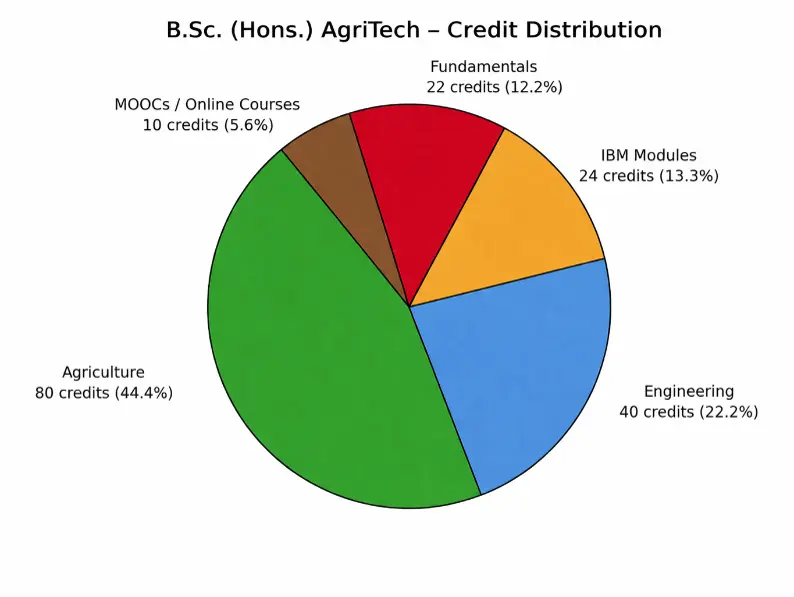
Well-balanced multidisciplinary structure with 80 credits in Agriculture, 40 in Engineering, 24 in IBM modules and 20 Student READY/Internship program .

Choice-based elective specialization in the seventh semester, with options in agribusiness management, climate-resilient agriculture, precision farming, biotechnology, protected cultivation, and post-harvest technology.

Student READY / RAWE / Industrial Attachment / Internship (20 credits) in the final semester for intensive field and industry exposure.

10 non-graded MOOC / online course credits through platforms such as SWAYAM and NPTEL to encourage continuous learning.

Focus on entrepreneurship, digital agriculture, agri-supply chains, and technology-driven decision-making, preparing students for careers in agritech, agribusiness, startups, research, and allied sectors.

Specializations Offered

The B.Sc. (Hons.) AgriTech curriculum is designed as a multidisciplinary programme integrating agricultural sciences, engineering, and industry-oriented technology modules. The programme comprises Agriculture Core Courses – 80 credits, Engineering Fundamental Courses – 40 credits, IBM Industry Modules – 24 credits, Skill Enhancement Courses – 12 credits (across agriculture, engineering, and technology domains), Internship / Student READY – 20 credits, and Online Courses / MOOCs – 10 non-gradial credits. The total academic requirement of the programme is 160 credits + 10 non-gradial MOOC credits.

The curriculum is structured to provide a balanced blend of domain knowledge, technical expertise, and industry exposure, with opportunities for elective specialization in the final year across emerging areas such as agribusiness management, precision agriculture, climate-resilient agriculture, biotechnology, protected cultivation, and digital agriculture.

The program aims at providing the students with:

The B.Sc. (Hons.) AgriTech programme aims to provide students with:

A multidisciplinary understanding of agriculture, engineering, digital technologies, sustainability, and agribusiness.

Practical and professional skills for technology-enabled, data-driven, and sustainable agricultural systems.

Elective specialization options in emerging areas such as agribusiness, precision agriculture, climate-resilient agriculture, biotechnology, protected cultivation, and post-harvest technology.

Programme Structure

Kaveri University, School of Agriculture can position the B.Sc. (Hons.) AgriTech programme as a blended, multidisciplinary curriculum with emphasis on academic grounding, practical skill development, experiential learning, industry engagement, entrepreneurship, and applied agritech training. The programme integrates classroom instruction, laboratory practicals, field visits, skill enhancement modules, IBM industry-oriented modules, end-semester projects, internships, elective specialization, and Student READY components.

Each undergraduate student in the B.Sc. (Hons.) AgriTech programme is required to complete 164 academic credits, in addition to 10 non-graded online / MOOC credits completed over the span of the degree programme.

Deeksharambh as an induction-cum-foundation course at the start of semester I

Educational / Study Tours for experiential learning

Internships for practical exposure and industry readiness, as well as for multiple exit options

Final semester Student READY / RAWE / Industrial Attachment / Project Work / Internship to provide hands-on experience in real-world agritech applications

...

Career Pathways

A B.Sc. (Hons.) AgriTech graduate has diverse career opportunities at the intersection of agriculture, technology, engineering, and data-driven innovation. The programme equips students with skills in precision agriculture, digital farming, AI, IoT, agribusiness, and sustainable agriculture, preparing them for emerging careers in the modern agricultural ecosystem.

Career Roles Include:

Government Sector Graduates can pursue careers in agricultural departments, rural development agencies, government projects, and public sector organizations. Roles include Agricultural Officer, Extension Officer, Project Officer, Research Assistant, and Agri-Tech Coordinator through competitive examinations and recruitment processes.

Banking & Financial Services AgriTech graduates are eligible for positions such as Agricultural Field Officer (AFO), Rural Development Officer, and Agri-Finance Executive in banks and financial institutions. These roles focus on agricultural credit, farm financing, crop insurance, and rural development initiatives.

AgriTech & Private SectorStrong opportunities exist in AgriTech companies, precision farming enterprises, drone technology firms, seed and input industries, smart irrigation companies, and digital agriculture platforms. Career options include Precision Agriculture Analyst, Farm Technology Executive, Agronomist, AgriTech Consultant, and Agri-Business Manager.

Industries & AgribusinessGraduates can work in food processing industries, agri-input companies, supply chain organizations, agri-logistics firms, and agribusiness enterprises. Positions include Operations Executive, Quality Assurance Officer, Supply Chain Manager, and Digital Agriculture Professional.

Research & Higher EducationWith advanced studies (M.Sc., M.Tech., or Ph.D.), graduates can pursue careers as Scientists, Researchers, Faculty Members, and Innovation Specialists in universities, research institutions, and technology-driven agricultural organizations.

Entrepreneurship The programme encourages students to establish ventures in precision farming services, drone-based agriculture, smart irrigation solutions, agri-advisory services, digital agriculture platforms, agri-processing units, and AgriTech startups.

Other Opportunities Career prospects are also available in NGOs, international development agencies, climate-smart agriculture projects, sustainability initiatives, crop insurance companies, and environmental management organizations.

Overall, a B.Sc. (Hons.) AgriTech degree opens pathways to dynamic careers in agriculture, technology, innovation, research, entrepreneurship, and agribusiness, both in India and globally.

Credit Load

Summary of Credit Distribution among different categories of
Course (Credit Hours)

Semester Agriculture Courses Engineering Courses IBM Modules Skill Enhancement Courses (SEC) Elective Courses Internship / Project / Student READY Total Credits Non-Gradial Courses Online Course / MOOC
I 12 4 3 2 -- -- 21 2Weeks
II 15 2 3 2 -- -- 22 --
III 9 6 5 2 -- -- 22 --
IV 9 9 3 2 -- -- 23 --
V 11 7 3 2 -- -- 23 --
VI 12 4 3 2 -- -- 23 --
VII -- -- -- -- 18 -- 18 --
VIII -- -- --- -- -- 15 15 --
Total 68 32 20 12 18 15 165 2Weeks 10*

Eligibility Criteria

Qualify in EAPCET (Formerly EAMCET) 2026 examination OR ICAR AIEEA 2026

Qualify in Common Entrance Test for Agriculture UG Course in different states (for example, KCET, CG PAT, CUET-UG, MHT CET, AGRICET, AP EAMCET, TNAU CET etc)

Preference will be given to candidates who have appeared for a National or State-level entrance examination (such as ICAR AIEEA, State Agriculture CET, etc.).

Note:
(i) Students getting admitted through entrance test mode need to have 60% or equivalent grade in 10+2 from any Statutory Board; (ii) Exact cut off rank would be announced upon declaration of results.

Fee Structure

Students Under Indian Category ₹ Per Annum
Academic Fees ₹ 3,00,000
Hostel Fees
(2 Sharing Includes Room & Mess Charges)
₹ 1,50,000
Hostel Fees
(4 Sharing Includes Room & Mess Charges)
₹ 1,25,000
Caution Deposit
(Refundable at the End of the Course or After Graduation)
₹ 20,000
Students Under PIO/NRI Category $ USD Per Annum
Academic Fees $3500
Hostel Fees
(Includes Room & Mess Charges)
$2000
Caution Deposit
(Refundable at the End of the Course or After Graduation)
$400

Note:
Hostel stay is mandatory for students of B.Sc. (Hons.) Agriculture programme and all fees are subject to revision every year.

Refund Rules:
Fee refund & cancellation policy will be as per guidelines published by UGC/Statutory authorities.

Note:

Hostel stay is mandatory for students of B.Sc. (Hons.) Agriculture programme and all fees are subject to revision every year.

Refund Rules:

Fee refund & cancellation policy will be as per guidelines published by UGC/Statutory authorities.

Important Dates

Important Dates to Remember (Subject to Revision)

Last Date to receive Application for Admissions 2026 -10thJuly, 2026

Merit List / Counselling -20thJuly, 2026

Orientation and Classes Begin -01stAugust, 2026

Note:
EAPCET/EAMCET interactions will be held in virtual mode only. Dates and schedules are subject to change.

Kaveri University was established as per the Telangana Private Universities (Establishment & Regulation) Act, 2018 under section 3.

Admissions Open 2026-27