The School of Agriculture at Kaveri University, Gowraram, Hyderabad, offers a four-year B.Sc. (Hons.) Horticulture degree programme organized over eight semesters. The curriculum integrates classroom teaching with practical training, skill and ability enhancement courses, field exposure, internships, study tours, elective specialization, research orientation, and ethical values. Designed in accordance with the ICAR Sixth Deans’ Committee recommendations and aligned with the National Education Policy (NEP) 2020, the programme provides a strong foundation in contemporary horticultural science with emphasis on crop production, plant propagation, nursery management, protected cultivation, postharvest handling, sustainability, entrepreneurship, and experiential learning.
The B.Sc. (Hons.) Horticulture programme aims to prepare a new generation of horticulture professionals with sound scientific understanding, technical competence, and practical skills in growing fruits, vegetables, flowers, plantation crops, precision farming, value addition, crop protection, and integrated farming systems. It is designed to equip students to respond effectively to emerging challenges such as climate resilience, nutritional security, protected cultivation, postharvest losses, efficient resource use, urban horticulture, and sustainable horticultural enterprise development.
Kaveri University is committed to nurturing future citizens who can contribute to a better world as leaders, innovators, and responsible professionals. The University seeks to shape learners who are capable of influencing the future while staying closely connected to their communities, agriculture, and the environment. This broader vision aligns well with horticultural education, which brings together productivity, sustainability, entrepreneurship, and social responsibility.
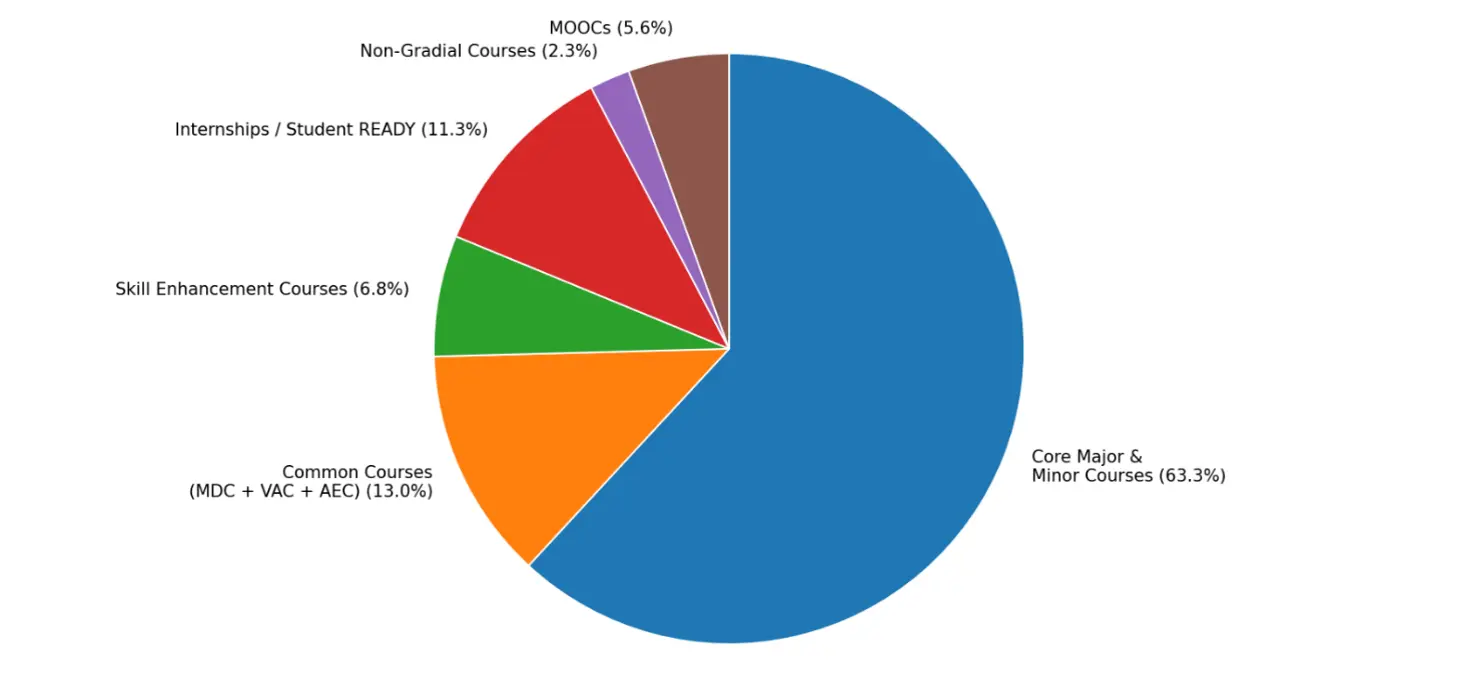
The B.Sc. (Hons.) Horticulture curriculum is based on a core programme in horticultural sciences comprising Core Courses (Major + Minor) – 112 credits, Multidisciplinary Courses – 9 credits, Value Added Courses – 6 credits, Ability Enhancement Courses – 8 credits, Skill Enhancement Courses – 12 credits, Internship / Student READY – 20 credits, Non-Gradial Courses – 4 credits, and Online Courses / MOOCs – 10 credits. The total academic requirement is 167 credits + 10 online / MOOC credits.
A multidisciplinary perspective through integration of horticultural science, basic sciences, technology, sustainability, agribusiness and field-level experiential learning for understanding and addressing real-world challenges in horticulture.
A diverse set of methods and skills for analytical thinking, practical problem solving, field experimentation, nursery and crop management, postharvest handling, value addition, entrepreneurship and communication—essential for professional, academic and enterprise-oriented success.
Specialization in the final phase of the programme through elective streams in Fruit Science, Vegetable Science, and Floriculture and Landscaping
KKaveri University School of Agriculture can position the B.Sc. (Hons.) Horticulture programme as a blended curriculum with emphasis on academic grounding, practical skill development, experiential learning, industry exposure, entrepreneurship and applied horticultural training. The programme integrates class room instruction, practicals, field visits, skill enhancement modules, internships, study tour, elective specialization and Student READY components.
Each undergraduate student in B.Sc. (Hons.) Horticulture is required to complete 167 academic credits, in addition to 10 credits of online / MOOC courses completed during the span of the degree programme.
The programme also incorporates:
Deeksharambh as induction-cum-foundation course
Educational Tour / Study Tour
Internship for exit options
Final semester Student READY / RAWE / Industrial Attachment / Project Work / Internship
A B.Sc. (Hons.) Horticulture graduate has diverse career opportunities across horticulture, agriculture, agribusiness, protected cultivation, food processing, landscaping, research, and entrepreneurship. The programme equips students with scientific knowledge and practical skills in fruit and vegetable production, floriculture, nursery management, protected cultivation, post-harvest technology, precision horticulture, and sustainable production systems, preparing them for rewarding careers in both traditional and emerging horticultural sectors.
Career Roles Include:
Government Sector Graduates can pursue careers in the Departments of Horticulture and Agriculture, National Horticulture Board (NHB), Mission for Integrated Development of Horticulture (MIDH), ICAR institutes, Krishi Vigyan Kendras (KVKs), State Agricultural Universities, APEDA, commodity boards, and public sector organizations. Career opportunities include Horticulture Officer, Technical Officer, Project Officer, Research Assistant, Farm Manager, Extension Officer, and Quality Control Officer through competitive examinations and recruitment processes.
Banking & Financial Services Horticulture graduates are eligible for positions such as Agricultural Field Officer (AFO), Rural Development Officer, Horticulture Credit Officer, and Agri-Finance Executive in banks and financial institutions. These professionals support agricultural credit, horticultural enterprise financing, crop insurance, value-chain financing, and rural development programmes.
Horticulture & Private SectorExcellent opportunities exist in commercial horticulture enterprises, seed and nursery companies, greenhouse and protected cultivation industries, floriculture companies, precision farming organizations, tissue culture laboratories, irrigation companies, and agri-input industries. Career options include Production Executive, Horticulturist, Greenhouse Manager, Nursery Manager, Crop Production Specialist, Precision Horticulture Consultant, and Technical Sales Executive.
Industries & AgribusinessGraduates can work in food processing industries, fruit and vegetable processing units, post-harvest management companies, export organizations, supply chain enterprises, cold storage industries, retail chains, and agribusiness firms. Positions include Operations Executive, Quality Assurance Officer, Post-Harvest Manager, Supply Chain Executive, Procurement Officer, and Agribusiness Manager.
Research & Higher EducationWith advanced studies (M.Sc., MBA, or Ph.D.), graduates can pursue careers as Scientists, Researchers, Faculty Members, Plant Breeders, Post-Harvest Specialists, and Research Associates in universities, ICAR institutes, research organizations, biotechnology companies, and horticultural research centres.
Entrepreneurship The programme encourages graduates to establish enterprises such as commercial fruit orchards, vegetable production farms, floriculture units, protected cultivation projects, hydroponic and vertical farming systems, tissue culture laboratories, commercial nurseries, mushroom production units, organic farming enterprises, landscape consultancy firms, post-harvest and value-addition units, horticultural input dealerships, and export-oriented horticulture businesses.
Other Opportunities Career prospects are also available in NGOs, international development agencies, sustainable agriculture projects, urban horticulture and smart city initiatives, environmental organizations, landscape architecture firms, consultancy services, certification agencies, horticultural export companies, and climate-resilient agriculture programmes.
Summary of Credit Distribution among different categories of
Course (Credit Hours)
| Semester | Core Courses (Major+Minor) | Multidisciplinary Course (MDC) | Value Added Course (AEC) | Ability Enhancement Course (AEC) | Skill Enhancement Course (SEC) | Internship / Project / Student READY | Total Credits | Non-Gradial Courses | Internship | Online Course / MOOC | |
|---|---|---|---|---|---|---|---|---|---|---|---|
| I | 11 | 3(2) | -- | 1(3)+2(4) | 1 | -- | 21 | 2 (1) | -- | ||
| II | 9 | 3(5) | 3(6) | 1(3)+2(4) | 1 | -- | 22 | -- | 10(12) | ||
| III | 16 | -- | 2(8) | 2 | -- | 20 | -- | ||||
| IV | 14 | 3(9) | 3(10) | -- | 2 | -- | 22 | -- | 10(13) | ||
| V | 20 | -- | -- | -- | -- | -- | 20 | 2(11) | -- | ||
| VI | 22 | -- | -- | -- | -- | -- | 22 | -- | -- | ||
| VII | 20 | -- | -- | -- | -- | -- | 20 | -- | -- | ||
| VIII | -- | -- | -- | -- | -- | 20 | 20 | -- | -- | ||
| Total | 112 | 9 | 6 | 8 | 12 | 20 | 167 | 4 | 10 |
Note:
(i) Students getting admitted through entrance test mode need to have 60% or equivalent grade in 10+2 from any Statutory Board; (ii) Exact cut off rank would be announced upon declaration of results.
| Students Under Indian Category | ₹ Per Annum |
|---|---|
| Academic Fees | ₹ 3,00,000 |
| Hostel Fees (2 Sharing Includes Room & Mess Charges) |
₹ 1,50,000 |
| Hostel Fees (4 Sharing Includes Room & Mess Charges) |
₹ 1,25,000 |
| Caution Deposit (Refundable at the End of the Course or After Graduation) |
₹ 20,000 |
| Students Under PIO/NRI Category | $ USD Per Annum |
|---|---|
| Academic Fees | $3500 |
| Hostel Fees (Includes Room & Mess Charges) |
$2000 |
| Caution Deposit (Refundable at the End of the Course or After Graduation) |
$400 |
Note:
Hostel stay is mandatory for students of B.Sc. (Hons.) Horticulture programme and all fees are subject to revision every year.
Refund Rules:
Fee refund & cancellation policy will be as per guidelines published by UGC/Statutory authorities.
Note:
Dates and schedules are subject to change.
Kaveri University was established as per the Telangana Private Universities (Establishment & Regulation) Act, 2018 under section 3.