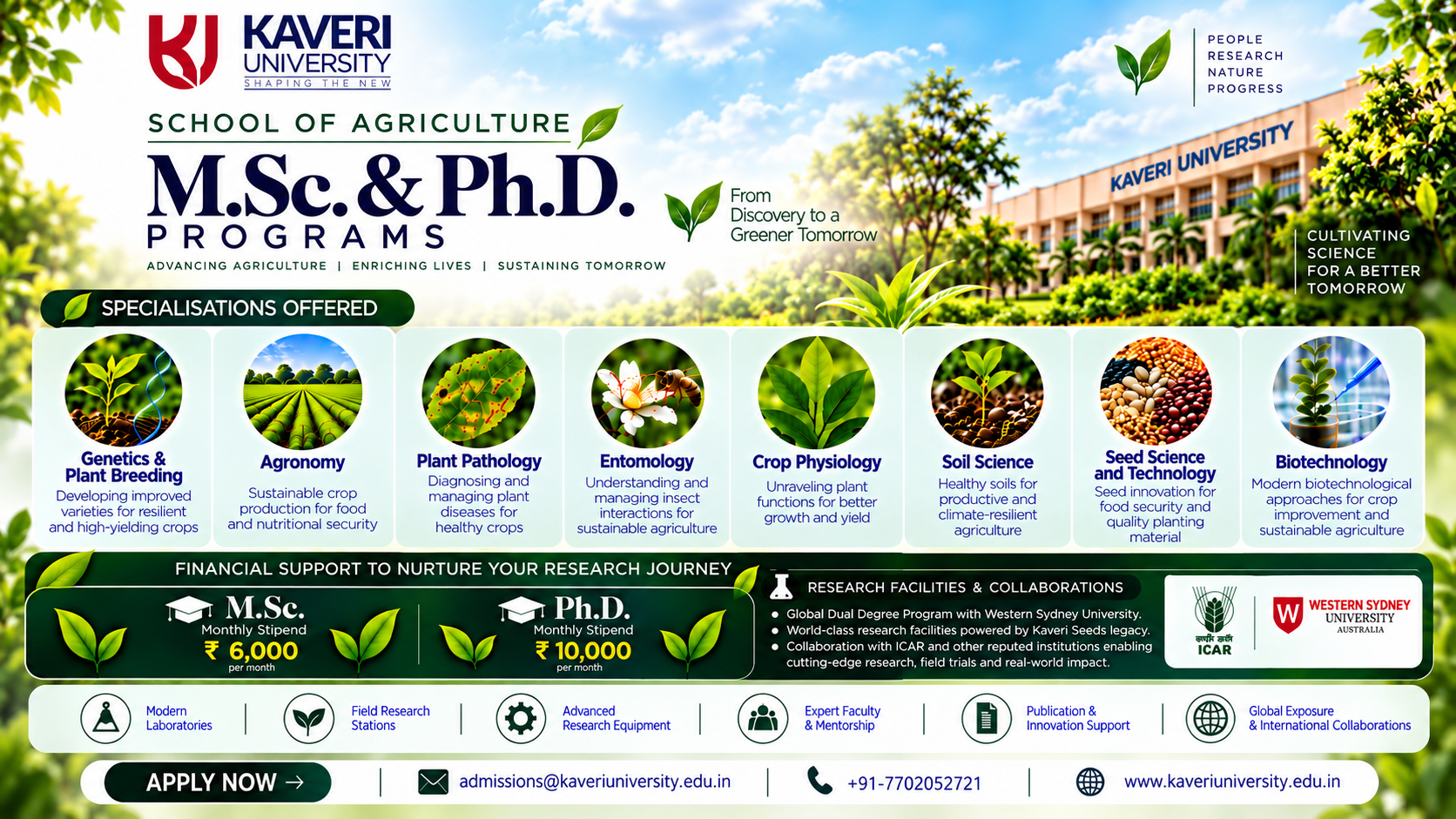
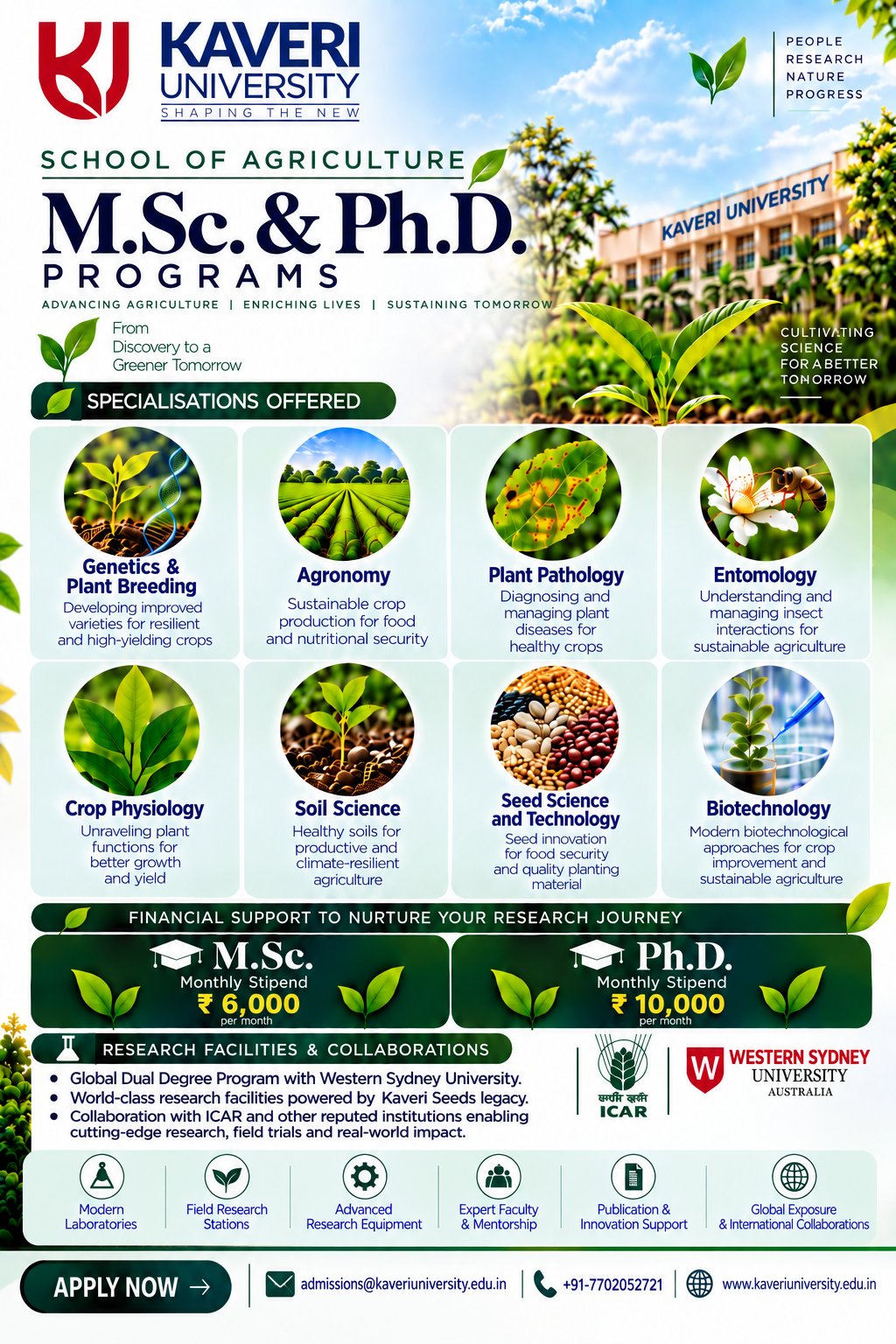
PG programme (Soil Science & Agricultural Chemistry)

...

Programme Overview

The Post Graduate Agriculture program with a specialization in Soil Science and Agricultural Chemistry is either M.Sc. or Ph.D. degree at School of Agriculture, Kaveri University that focuses on the scientific study of soils, fertilizers, soil health and their application in agriculture and relation in environmental protection. The program aims to provide students with a comprehensive understanding of soil science, agricultural chemistry, and their applications in sustainable agriculture.

Our Vision

Empowering Global Agricultural Leaders: The programme aims to cultivate the next generation of leaders in soil science, who will drive innovations in sustainable agricultural practices and environmental stewardship across the world, contributing to food security and climate resilience.

Integrating Technology with Sustainability: By emphasizing the use of cutting-edge technologies such as remote sensing, GIS, and AI, the course equips students with the tools to enhance crop productivity while minimizing environmental impact, ensuring the future of agriculture is both high-yielding and sustainable.

Fostering International Collaboration and Research Excellence: The programme offers students opportunities to engage in global research initiatives and exchange programmes with leading international institutions, giving them valuable cross-cultural and interdisciplinary perspectives on addressing environmental and agricultural challenges.

Programme Highlights

State-of-the-Art Facilities: Students will have access to world-class laboratories and agricultural farm fields, including Soil Testing Labs, Plant Growth Chambers, Precision Agriculture Labs, and Pollution Research Labs.

International Research Opportunities: Collaborative projects with global experts, joint thesis work, and international exchange programmes broaden the scope of student research and learning.

Technological Integration: Exposure to advanced technologies such as drone applications, image/spectral processing tools, and big data analytics to enhance soil management and agricultural practices.

Sustainability Focus: A core emphasis on climate-smart agriculture, organic farming, and sustainable soil and water management practices to mitigate climate change impacts.

Analytical and problem-solving skills:Ability to analyze and interpret data related to soil science and agricultural chemistry.

Communication and collaboration skills:Ability to communicate effectively with farmers, researchers, and policymakers.

Knowledge of soil science and agricultural chemistry:Understanding of soil properties, fertility, and management practices.

Environmental awareness:Understanding of environmental impacts of agricultural practices and strategies for sustainable agriculture.

Curriculum Overview

The curriculum of the PG programme integrates core and specialized subjects essential for the development of well-rounded professionals in soil science. Key areas of study include:

Soil Fertility and Plant Nutrition

Remote Sensing and GIS Techniques

Precision Agriculture and Smart Farming Technologies

Variable Rate Technology (VRT)

Data Analytics in Agriculture

Climate-Smart Agriculture and Soil Microbiomes

Nanotechnology in Soil Management

Plastic Pollution and Forever Chemicals in Agriculture

Pollution Control

Conservation Agriculture and Water Management

The programme’s hands-on approach ensures that students not only gain theoretical knowledge but also practical experience in applying these concepts through fieldwork, laboratory experiments, and collaborative projects.

Duration:

M.Sc.: 2 years (4 semesters)

Ph.D.: 3 years (6 semesters)

Objectives:

Develop Expertise in Sustainable Soil Management: Equip students with the knowledge and skills to sustainably manage soil and water resources, with a focus on enhancing agricultural productivity while minimizing environmental degradation.

Foster Technological Proficiency: Provide students with advanced tools and techniques, such as GIS, precision agriculture, and AI, to optimize soil health and crop yield.

Encourage Global Research and Collaboration: Offer opportunities for international research and exposure to global agricultural practices, preparing students to become leaders in soil science worldwide.

Equip Students for Professional Leadership: Prepare graduates to take on leadership roles in both public and private sectors, with a strong foundation in scientific research, policy-making, and sustainability practices.

Programme Structure

The structure of the Post-Graduate Programme is designed to balance theoretical learning with practical skill development:

Core Courses: Students will undertake foundational courses in soil science, soil fertility, water management, and climate-smart agriculture.

Elective Courses: Specialized courses in advanced topics such as nanotechnology, remote sensing, pollution research, and data analytics will allow students to tailor their learning to their career interests.

Hands-on Training:Students will engage in laboratory experiments, fieldwork, and practical research projects to apply theoretical knowledge to real-world scenarios.

International Collaborations: Students will have the opportunity to participate in exchange programmes, joint research, and collaborative thesis work with international institutions.

The programme offers a blend of classroom teaching, practical training, and research opportunities, ensuring that students gain a comprehensive understanding of soil science and its role in sustainable agriculture.

...

Credit Load – M.Sc.

Summary of Credit Distribution among Different Categories of the
Course (Credit Hours)

Semester Major Courses Minor Courses Supporting Courses Common Courses Seminar Research Total
I 11 3 0 3 0 0 17
II 9 5 3 2 0 0 19
III -- -- 3 0 1 15 19
IV 0 0 0 0 0 15 15
Total 20 8 6 5 1 30 70

Credit Load - Ph.D.

Summary of Credit Distribution Among Different Categories of the
Course (Credit Hours)

Semester Major Courses Minor Courses Supporting Courses Seminar Research Total
I 7 6 3 1 0 17
II 5 0 2 1 9 17
III 0 0 0 0 16 16
IV 0 0 0 0 17 17
V -- -- -- -- 17 17
VI -- -- -- -- 16 16
Total 12 6 5 2 75 100

Eligibility Criteria

M.Sc. The Program is open to candidates with Bachelor's degree in Agriculture or any equivalent degree from Institute/Colleges having ICAR accreditation and affiliated colleges with SAUs having ICAR accreditation or government- recognized private/ autonomous university with a minimum CGPA of 6/10.

Ph.D. M.Sc. in Soil Science and Agricultural Chemistry with a minimum OGPA of 6.50/10.00 (or equivalent) from Institute/Colleges having ICAR accreditation and affiliated colleges with SAUs having ICAR accreditation or government- recognized private/ autonomous university.

The basic degree of four (4) years duration from Institute/Colleges having ICAR accreditation and affiliated colleges with SAUs having ICAR accreditation or government-recognized private/ autonomous university.

Note:
(i) Students getting admitted through entrance test mode need to have 60% or equivalent grade in 10+2 from any Statutory Board.
(ii) Exact cut-off rank would be announced upon declaration of results.

Key Areas of Study

Soil Science: Study of soil formation, classification, morphology, physics, chemistry, and biology.

Agricultural Chemistry:Study of chemical processes and principles that govern soil fertility, plant nutrition, and environmental sustainability.

Soil Fertility and Nutrient Management: Study of soil fertility, nutrient cycling, and management practices to optimize crop production.

Soil Conservation and Management: Study of soil erosion, conservation, and management practices to promote sustainable agriculture.

Environmental Sustainability: Study of environmental impacts of agricultural practices and strategies for sustainable agriculture.

Career Opportunities

Soil Scientist:– Conduct research and analysis on soil properties, fertility, and management practices.

Agricultural Chemist*: – Develop and implement agricultural chemical products and practices that promote sustainable agriculture.

Soil Conservationist*:– Develop and implement soil conservation and management plans to promote sustainable agriculture.

Environmental Consultant*: – Conduct environmental impact assessments and develop strategies for sustainable agriculture.

Academic/Researcher*:– Conduct research and teach soil science and agricultural chemistry at universities and research institutions.

Fee Structure

Students Under Indian Category ₹ Per Annum
Academic Fees
(All Inclusive Academic Fees)
₹ 3,00,000
Hostel Fees
(2 Sharing All Inclusive Hostel & Mess Charges)
₹ 1,50,000
Hostel Fees
(4 Sharing All Inclusive Hostel & Mess Charges)
₹ 1,25,000
Caution Deposit
(Refundable at the End of the Course or After Graduation)
₹ 20,000
Students Under PIO/NRI Category $ USD Per Annum
Academic Fees $5000
Hostel Fees
(Includes Room & Mess Charges)
$2000
Caution Deposit
(Refundable at the End of the Course or After Graduation)
$400

Refund Rules:
Fee Refund & Cancelation Policy will be as per guidelines published by UGC / Statutory Authorities.

Important Dates

Important Dates to Remember (Subject to Revision)

Last Date to receive Application for Admissions 2025 -5thOctober, 2025

Merit List / Counselling -10thOctober, 2025

Orientation and Classes Begin -13thOctober, 2025

Kaveri University was established as per the Telangana Private Universities (Establishment & Regulation) Act, 2018 under section 3.